
Culture of Jaraguá
Religious festivals brought by the Portuguese, folk revelries, street Carnival and a folklore rich in legends passed down from generation to generation.
Festivals and traditions
The town has countless festivals. The Festa do Divino Espírito Santo (Feast of the Holy Spirit), held 49 days after Easter Sunday, and its Cavalhadas were brought by the Portuguese. Inspired by the equestrian tournaments of the Iberian Peninsula and by the tales of Charlemagne and the Twelve Peers of France, the Cavalhadas re-enact the battle between Christians and Moors as a religious and community ritual, kept alive by only a few towns in Brazil. Learn more on the Cavalhadas of Jaraguá page.
The Festa do Peão (rodeo) is part of Jaraguá's anniversary celebrations, in the week of July 29. Street Carnival is one of the liveliest festivals in the region; it opens with the Bloco do Zé Pereira, in which men dress as women and vice versa. And not to be forgotten is the Folia de Reis (Three Kings revelry), in early January, which takes place in several parts of the municipality. See the full festival calendar.
Legends of Jaraguá
The town has many legends that are part of local folklore and have been published in books. Here are three stories, told in the same spirit in which local people tell them.
Teresa Bicuda
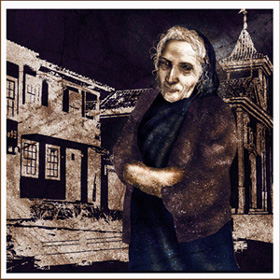
In the deeply religious and strictly moral world of the old Vila de Jaraguá, Teresa Bicuda was a social aberration. An unbeliever, she never set foot in church. When she was forced to walk past one, she turned her face away and cursed under her breath. The odd protrusion of her misshapen lips earned her the nickname Teresa Bicuda ("Beaky Teresa"). She worked on Sundays, so that everyone could see she did not respect the traditions of the Church.
She was an offense to the conscience of the pious old women who went to Jaraguá's churches and chapels every day, and the terror of the idle boys. The men, who did not fear her, despised her.
One day, Teresa Bicuda died. Not a single tear fell from any Christian eye. Whoever had not known how to live, and had not called the priest at her final hour, deserved neither tears nor pity.
It was a colonial custom to bury the dead inside the churches. There were no cemeteries in Jaraguá yet. The little Rosário chapel, at the foot of a gentle hill, had always received the bodies of the poor, who could not afford the luxury of being buried inside the Mother Church. So Teresa Bicuda was buried in the little Rosário chapel, without any ceremony.
For three nights in a row, as midnight struck, the frightened townspeople heard Teresa Bicuda screaming for her body to be taken out of the chapel. That was not her place in death, just as it had not been in life. At the end of the third day, at the stroke of midnight, Teresa Bicuda rose from her grave and ran through the quiet streets of the town, screaming in despair.
Terror froze everyone who heard her. From that night on, those out late always saw a huge white figure appear at the end of the street, running and dropping tongues of fire from its filthy clothes, filling the air with the foul smell of sulfur. Wherever she passed, she left traces of her sins. The scorched grass withered. Animals turned up with singed fur.
The people wanted to put an end to their torment. The bravest men of the town exhumed Teresa Bicuda and carried her body up to the Serra de Jaraguá. There, in a stony place, they threw it down. A strong smell of sulfur filled the air. Not a single plant ever grew on that spot again, but Teresa Bicuda never again terrified the peaceful people of Jaraguá with her screams.
Source: Teixeira, José Aparecido. Folclore goiano: cancioneiro, lendas, superstições. 3rd ed. São Paulo: Companhia Editora Nacional; Brasília: INL, 1979, pp. 208-209 (Brasiliana, 306).
The horseman of Rua das Flores
My godfather, whose name was João, lived with my grandmother, here on Rua das Flores. She was the one who raised him. When he became a young man, he wanted to move out of my grandmother's house, because he wanted his freedom. The old folks were very strict and didn't like him staying out late.
Across the street from my grandmother's house there was a haunted house. It belonged to some people who lived out on a farm. So he decided to rent a room in that house and started sleeping there. People kept telling him: "You'll see... You'll see a ghost in that house yet." He answered: "There's nothing there. I don't believe in those things." "There's a horseman who comes and dismounts right there at the door. The horse is shod and all. You'll get a scare yet." "I don't believe that, no. There's no such nonsense." And he stayed on in that house.
Then one day, during Lent, he says he came home, opened the front room and went into his bedroom. Back then there was no electricity here. He lit a candle, put it on a chair by the head of the bed and, not feeling sleepy, picked up a novel to read. He was a teacher here in Jaraguá. He was absorbed in his reading, not thinking about ghosts at all... Meanwhile, the horse came... clop... clop... clop... with its horseshoes. It stepped onto the sidewalk, struck the big stone at the door, went "clack". Then he heard the horseman dismount, dragging his spurs. He was sure the door was locked; he had just locked it. And the horseman kept dragging his spurs through the house. He thought: "He's coming to my room." He opened the window and ran to my father's house, close by, on the same Rua das Flores. He got there in nothing but his underwear, calling for my mother and my father.
"The horseman is there, auntie. He came into the house. He didn't get as far as my room, but I heard him dragging his spurs. I even heard the horse snorting at the door! I heard the horseshoe hitting the stone!" My father and he went to fetch the mattress: the door was locked and the window was open. That night he slept at my father's house and never again wanted to spend the night in that house. He went back to my grandfather's house and gave up a lot of the partying he used to do.
Many people saw that horseman dismounting at that house. They say he was the husband of the woman who lived there, who wasn't exactly well-behaved. The husband lived on the farm and came at night to see whether she was behaving herself. When he died, he kept up this mischief, haunting the place.
The Procession of the Dead
Here in Jaraguá, on the Largo do Rosário, there lived a woman who was always at her window prying into other people's lives. She gossiped about this one and that one, about young girls, about everything. Evening came and she was still at the window. Night fell, everyone went to bed, and she stayed there until midnight.
One day, they say, while she was at the window, a very long procession passed right in front of her house. She looked at one person, then another, but didn't recognize anyone. Then a young woman left the procession, came up to the window and said: "Look, ma'am, take these candles. I want you to keep them for me until tomorrow and give them back to me at this same hour."
She took the candles, uneasy. When the procession was over, she looked at them and saw they were dead men's shins: the shinbones of the dead. She was so upset she couldn't sleep all night, thinking she had to give those bones back.
The next night, she stood at the window with the candles in her hand. When the procession came, the young woman approached and said: "Listen. This is a procession of the dead. These candles are the bones of people who have died. Don't stay at the window anymore, prying into other people's lives, because that is very ugly, very wrong, it's even a sin."
Heritage
The Rosário Church (1776), the Nossa Senhora da Penha Mother Church (first chapel from 1748, rebuilt in 1950), the Conceição Church (begun in 1828), the House of Father Silvestre and the old mansions downtown tell the material history of the town. Discover them in the historic center and in the history of Jaraguá.
Updated on September 24, 2026